1Watch the YouTube video of Black Box/Chambre Noire then choose an OPO character you would like to assess
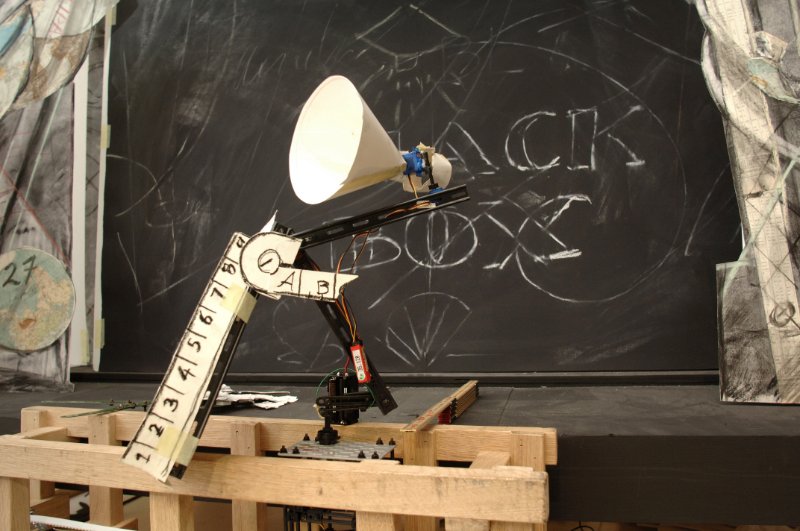 Megaphone announces an act of mourning (trauerarbeit).
Megaphone’s second performance is singing Sarastro’s aria In Diesen Heil’gen Hallen, drawing a connection between the aria and the rhinoceros hunt video to establish a juxtaposition. The aria is about peace, while the video depicts a cruel hunt. De Jong (2018, p.21) states that this video is an ironic demonstration of what European enlightenment cost Africa.
Megaphone’s third appearance is in the group ensemble.
Megaphone’s final appearance is with an animated rhinoceros’ projection as a waltz between the OPO and the rhinoceros. De Jong (2018, p.21) describes this vignette as “Germany’s colonial history meeting the nation’s Vergangenheitsbewältigung [coping with the past]”.
This would mean that the megaphone now calls to a close the ‘act of mourning’ it announced in the beginning of the performance.
Megaphone announces an act of mourning (trauerarbeit).
Megaphone’s second performance is singing Sarastro’s aria In Diesen Heil’gen Hallen, drawing a connection between the aria and the rhinoceros hunt video to establish a juxtaposition. The aria is about peace, while the video depicts a cruel hunt. De Jong (2018, p.21) states that this video is an ironic demonstration of what European enlightenment cost Africa.
Megaphone’s third appearance is in the group ensemble.
Megaphone’s final appearance is with an animated rhinoceros’ projection as a waltz between the OPO and the rhinoceros. De Jong (2018, p.21) describes this vignette as “Germany’s colonial history meeting the nation’s Vergangenheitsbewältigung [coping with the past]”.
This would mean that the megaphone now calls to a close the ‘act of mourning’ it announced in the beginning of the performance.Megaphone
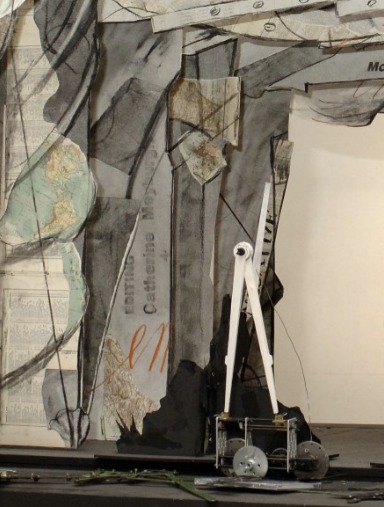 Divider represents the enlightenment that colonialism forced on its colonies.
Divider’s first appearance is in front of a projection of Kartes des Nördlichen Teilis von Deutsch-Südwest Afrika, translated as ‘Map of the northernly parts of German Southwest Africa’ (Kentridge 2005, 03:30-04:29). According to De Jong (2018, p.17), eighteenth-century European maps served as encyclopaedic knowledge, demonstrating areas that have been colonised and areas still in need of enlightenment.
Divider’s second appearance is in front of projections that depict the measuring and cataloguing of skulls (Kentridge 2005, 12:01-13:42). This vignette references the study of skulls by German scientists who measured and compared the skulls of different races (Kentridge 2014a, p.51).
Divider’s final appearance is in the group ensemble (Kentridge 2005, 17:30-18:00).
Divider represents the enlightenment that colonialism forced on its colonies.
Divider’s first appearance is in front of a projection of Kartes des Nördlichen Teilis von Deutsch-Südwest Afrika, translated as ‘Map of the northernly parts of German Southwest Africa’ (Kentridge 2005, 03:30-04:29). According to De Jong (2018, p.17), eighteenth-century European maps served as encyclopaedic knowledge, demonstrating areas that have been colonised and areas still in need of enlightenment.
Divider’s second appearance is in front of projections that depict the measuring and cataloguing of skulls (Kentridge 2005, 12:01-13:42). This vignette references the study of skulls by German scientists who measured and compared the skulls of different races (Kentridge 2014a, p.51).
Divider’s final appearance is in the group ensemble (Kentridge 2005, 17:30-18:00).Divider
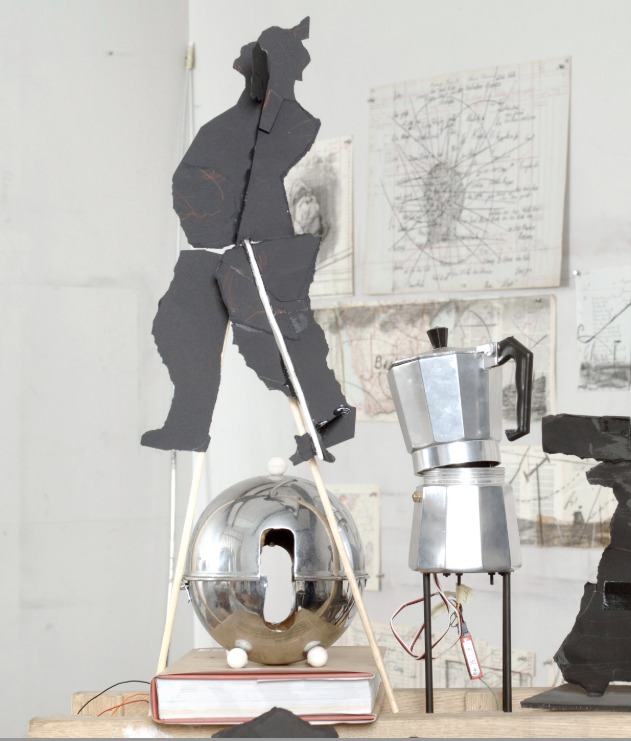 Throughout projected depictions of the natural resources claimed by the colonisers and acts of violence, Man ceaselessly continues its running. This appears to represent the resilience of the Herero that continued to fight for their homeland.
Man’s first appearance is with a projection of an incomprehensible spinning drawing (Kentridge 2005, 04:59-05:41).
In Man’s second appearance (Kentridge 2005, 09:30-11:48), Man runs in place, his journey is narrated through the projections of various objects and figures being shot and German advertisements mixed with violence and innovation.
Man’s final appearance is in the group ensemble with staccato movement to the pace of the music with a forward collapse motion (Kentridge 2005, 16:45-17:06).
Throughout projected depictions of the natural resources claimed by the colonisers and acts of violence, Man ceaselessly continues its running. This appears to represent the resilience of the Herero that continued to fight for their homeland.
Man’s first appearance is with a projection of an incomprehensible spinning drawing (Kentridge 2005, 04:59-05:41).
In Man’s second appearance (Kentridge 2005, 09:30-11:48), Man runs in place, his journey is narrated through the projections of various objects and figures being shot and German advertisements mixed with violence and innovation.
Man’s final appearance is in the group ensemble with staccato movement to the pace of the music with a forward collapse motion (Kentridge 2005, 16:45-17:06).Man
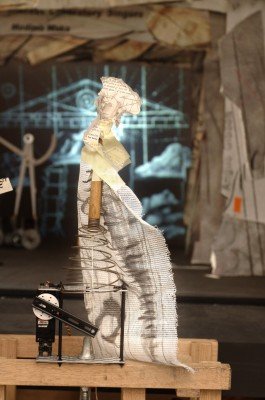 Woman 1 represents a survivor of the Herero genocide (De Jong 2018, p.19). Woman 1 is dressed in cultural Herero attire; the specific shape of the headdress represents the horns of cattle.
Woman 1’s first appearance is preceded by a projection that depicts several arrows converging on the title ‘Waterberg’ (Kentridge 2005, 07:13-08:39). De Jong (2018, p.12,19) describes Woman 1 as a grieving woman mourning the losses of the genocide, “The songs remember that those who survived the annihilation had no time to bury their dead and carried with them the ‘darkness of death’ on their flight to Botswana”.
Woman 1’s second appearance is during the group ensemble (Kentridge 2005, 17:04-20:25).
Woman 1 moves to centre stage for its final performance. In front of a projection titled Totenlist II, translated as ‘Death list II’, the projection zooms out to show the number of names that made it onto the list, quantifying the severity of the genocide. The lines and dots form constellations and depict shooting stars before coalescing into the form of a pangolin and the shutter of a camera, going dark as Woman 1 is still seen grieving.
Woman 1 represents a survivor of the Herero genocide (De Jong 2018, p.19). Woman 1 is dressed in cultural Herero attire; the specific shape of the headdress represents the horns of cattle.
Woman 1’s first appearance is preceded by a projection that depicts several arrows converging on the title ‘Waterberg’ (Kentridge 2005, 07:13-08:39). De Jong (2018, p.12,19) describes Woman 1 as a grieving woman mourning the losses of the genocide, “The songs remember that those who survived the annihilation had no time to bury their dead and carried with them the ‘darkness of death’ on their flight to Botswana”.
Woman 1’s second appearance is during the group ensemble (Kentridge 2005, 17:04-20:25).
Woman 1 moves to centre stage for its final performance. In front of a projection titled Totenlist II, translated as ‘Death list II’, the projection zooms out to show the number of names that made it onto the list, quantifying the severity of the genocide. The lines and dots form constellations and depict shooting stars before coalescing into the form of a pangolin and the shutter of a camera, going dark as Woman 1 is still seen grieving.Woman1
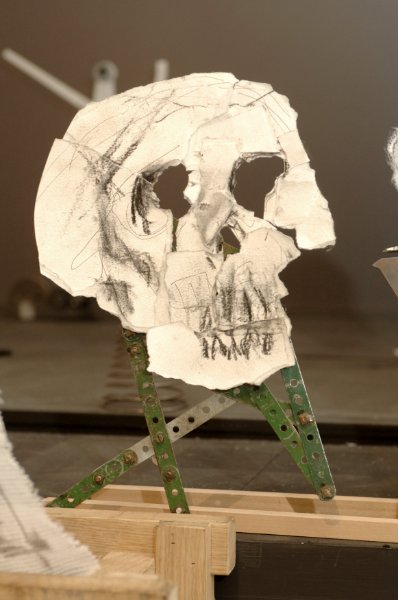 Skull acts out the Herero genocide (Kentridge 2014a, p.67).
Skull makes only one appearance during the group ensemble piece (Kentridge 2005, 16:34-17:16). It performs the same actions of beating itself apart and reconstructing again, an endless cycle of violence.
According to Lindenberger (2010, p.91), the Nazis sent murdered Herero’s skulls to Germany to advance studies on racial differences. Kentridge (2014a, p.38) describes how skulls were cleaned and “measured, analysed, catalogued – part of a rational, scientific project to make a taxonomy of human heads: the Aryan, the criminal, the Negro, the Jew – a new Great Chain of Being”. De Jong (2018, p.21) confirms that Skull signifies the murdered Hereros, who were scientific curiosities to study.
Skull acts out the Herero genocide (Kentridge 2014a, p.67).
Skull makes only one appearance during the group ensemble piece (Kentridge 2005, 16:34-17:16). It performs the same actions of beating itself apart and reconstructing again, an endless cycle of violence.
According to Lindenberger (2010, p.91), the Nazis sent murdered Herero’s skulls to Germany to advance studies on racial differences. Kentridge (2014a, p.38) describes how skulls were cleaned and “measured, analysed, catalogued – part of a rational, scientific project to make a taxonomy of human heads: the Aryan, the criminal, the Negro, the Jew – a new Great Chain of Being”. De Jong (2018, p.21) confirms that Skull signifies the murdered Hereros, who were scientific curiosities to study.Skull
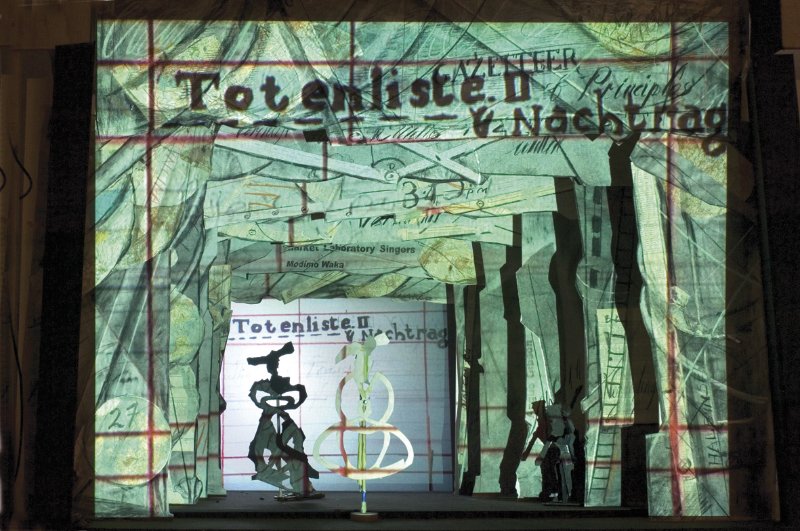 Woman 2 is only in the group ensemble. This figure features the Herero headdress, and the body consists of two curved overlapping frames. The minor role of the character represents the lack of justice for the Herero people.
Woman2